Once Again About the Negotiations Between Ukraine and Russia
and the Russian Armed Forces’ Possible Summer Offensive at the Front
Developments around the negotiations between Ukraine and Russia to end the war confirm their complicated nature. However, the talks are by no means at a standstill, and there are some signs of progress. As for Russia, it has intensified hostilities on the frontline in order to force Ukraine to agree to the terms of peace proposed by Russia. However, a full-scale offensive with a breakthrough of the front line is unlikely. The Western world realizes why Moscow is delaying the end of the war. It is because it is trying to achieve its goals. And the West has begun to unite its efforts to oppose it, while putting pressure on it. This also applies to the United States, which is by no means on Russia’s side. These concerted joint actions by Western countries could force the Kremlin to make concessions to Ukraine. However, it will resist to the last, as a decision to make concessions is nothing less than the Putin regime’s political collapse.
In our previous publications, we drew conclusions about the prospects for negotiations between Ukraine and Russia, as well as about a possible large-scale offensive by the Russian Armed Forces this summer. The main ones are as follows:
- the negotiations are extremely difficult, but not hopeless. Unfortunately, they are dragging on in time, although they are gradually moving forward, so some compromises will be reached under pressure from the EU and the US;
- Russia will not stop offensive actions on the front and may intensify them to last year’s level. However, it cannot launch a large-scale offensive with a breakthrough of the front line and occupying large areas of Ukraine and major cities.
Such estimates provoked a rather mixed reaction from the audience, including those who perceived them as too optimistic. To be honest, we also doubted that we were perceiving the situation correctly. Especially since most media and analysts cover it in a completely different way.
And this is quite understandable, as the situation is extremely complex and in many cases is deliberately distorted in the media as part of various information campaigns. Therefore, it makes sense to analyze these issues once again, taking into account the second round of negotiations between Ukraine and Russia on June 2, as well as the frontline events and the SBU’s strikes on the airfields of the Russian long-range (strategic) aviation and the Crimean bridge on June 1 and 3 this year.
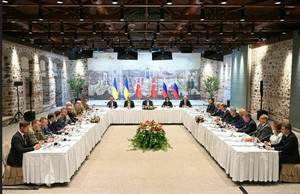
So, what can be said about the talks in Istanbul? As most experts predicted, Russia once again put forward demands unacceptable to Ukraine. We said the same things. That is, the meeting seemed to have ended without result. This is the general interpretation of the meeting.
However, some experts disagree, and their views are understandable. The talks demonstrated Moscow’s willingness to continue the dialogue, regardless of its goals. Therefore, there is still a possibility of reaching certain compromises, although this will require additional time. Immediately after the talks, Russian Presidenti’s Press Secretary Peskov confirmed their agreement in principle. He said that Russia could make some concessions in its memorandum on ending the war.
Of course, this can be perceived as a cover for the Kremlin’s true intentions to drag out the negotiations under the guise of demonstrating its “goodwill” and “flexibility” in its positions in order to avoid new sanctions from the EU and the USA. This assumption is seems to be true.
However, in any case, such a position of the Russian leadership shows that it is wary of tougher European and American sanctions. This explains a certain influence of Brussels and Washington on Moscow, which they can force to agree to reconciliation.
All of this is also understandable. Whatever the ambitions of the Kremlin and Putin personally, the economic situation in the country is forcing them to make concessions. These issues are widely covered in the media, so let’s focus on the most significant ones. For one, the macroeconomic parameters of the Russian economy in the first quarter of this year show a decline in its growth rate. And now its GDP is also declining. At the same time, the state budget deficit is growing rapidly.
Thus, economists’ predictions about Russia’s ability to continue the war in its current form no longer than until the end of this year are coming true. After that, the fighting must be stopped, as the country’s economy will not be able to sustain it and will find itself in a crisis with unpredictable consequences.
Russia will not be able to improve the economic situation in the country without ending the war, which is clear to everyone, including the Russian authorities. As a last resort, it can prolong the war for some time, introducing a regime similar to that of Soviet Russia during the Civil War or the USSR during the war with Nazi Germany. But this would not continue indefinitely, especially in the modern world and in today’s Russia, which cannot produce anything and only relies on China. That is why it is becoming the latter’s province. This does not help it much either, as shown by the state of most sectors of the Russian economy, including agriculture, which is no longer able to provide enough food.
Given this state of affairs, a logical question arises: why is Russia continuing the war? The answer seems to be obvious. To capture as much territory as possible and force Ukraine to surrender. This is exactly what Russia is trying to do by intensifying offensive actions at the front and attacking on new directions. In particular, these include Sumy and Kharkiv regions, which Russia also wants to seize.
Some people in Ukraine and in the West are already calling such actions by Moscow “the beginning of a summer offensive”. And representatives of the Russian leadership, including those at the negotiations, claim that the Russian Armed Forces retain full initiative and are confidently advancing. Based on such statements, the Kremlin is threatening Ukraine that it may lose not five but seven regions if it does not agree to give up Crimea and completely withdraw its troops from Donetsk, Luhansk, Kherson, and Zaporizhzhia regions.
These issues are currently of key importance in Russia’s war against Ukraine. Therefore, let’s look at them in more detail in the context of whether this is Moscow’s summer offensive and whether it can take place at all.
In order not to sound too optimistic again, let’s give the floor to the military, border guards, and local authorities of Ukraine’s frontline regions, who are on the front lines and know the situation better than anyone else. They can be trusted, because there is no point in hiding what is really happening. In addition, it would be better for them to exaggerate the complexity of the situation in order to obtain additional resources and justify themselves in case of some critical failures. However, they do not do this.
Thus, according to the statement by the Spokesperson for the Khortytsia Operational and Strategic Grouping of Troops, and in fact the Eastern Front, V. Trehubov in early June, Russia has not yet launched an active summer offensive. The situation at the front remains stable without significant escalations. The Ukrainian Defense Forces have not noticed a significant increase in combat clashes since the beginning of the summer. Their number has even slightly decreased, although this is within the limits of statistical error.
The Khortytsia OSG is part of the Kharkiv Operational and Tactical Group. Its Spokesperson, P. Shamshyn, has actually confirmed V. Trehubov’s words. According to his data and estimates, Russia is accumulating reserves in the Kharkiv sector, but they are not enough for a large-scale offensive. Especially to break through the front. The enemy conducts regular rotations, first of all of assault units, but continues to suffer significant losses, particularly near Vovchansk and Dvorichne.
He also pointed out that the occupiers are experiencing a shortage of armored vehicles due to the effective work of the Defence Forces of Ukraine. This makes the enemy use light vehicles to move in areas where drones are actively used, including motorcycles and ATVs.
The National Security and Defense Council of Ukraine, represented by Head of the Center for Countering Disinformation, A. Kovalenko, made a final assessment of the situation in Kharkiv region. He called the claims of the so-called Russian war correspondents about the beginning of Russia’s offensive on Kharkiv a blatant lie. In reality, the enemy’s main efforts are concentrated on the Kupiansk direction, and in the north of Kharkiv region they are conducting reconnaissance by small groups.
And again, let’s return to V. Trehubov, who is on the hottest part of the frontline in Ukraine. He believes that if there is a major escalation, it will probably take place in other parts of the front, namely in the north.
For him, the north is Sumy and Chernihiv regions of Ukraine, which are part of the area of responsibility of the Operational Command “North”, that is, our Northern Front. Unfortunately, we did not find any indicative statements by its representatives, although they certainly exist. Therefore, we refer to the State Border Guard Service of Ukraine and the Sumy Regional Administration.
According to the statement of the SBGS Spokesperson A. Demchenko, again in early summer, the enemy continues to exert pressure in the north of Sumy region within Yunakivska and Khotinska communities using small infantry groups on motorcycles and ATVs. The enemy is trying to expand the area of such actions, go deep into Ukrainian territory, get reinforcements and create opportunities to storm Ukrainian positions. At the same time, it is being covered by fire both on the territory of Ukraine and in Kursk region.
Head of the Sumy Regional State Administration O. Hryhorov says the same thing. He called the situation in the Sumy region’s border area difficult, dynamic, but under control. He also named the areas of Yunakivska and Khotinska communities as the area of the most intense fighting, where the enemy is acting in small groups and trying to gain a foothold. Civilians have long been evacuated from those areas. The Ukrainian Armed Forces are holding the line and disrupting Russians’ advance.
At the same time, the military, border guards, and local administration representatives acknowledge that Russians have seized a number of villages in the “gray zone” up to seven kilometers from the border, i.e., before the main line of defense of the Ukrainian Armed Forces.
The southern front is headed by the “Tavria” OSG. As in the East of Ukraine, the situation in the South of our country remains stably tense, but again without any major changes. According to the Spokesperson for the Southern Defense Forces Voloshyn, the enemy continues offensive actions on the Novopavlivka, Orikhove and Hulyaypillia directions. It uses small infantry groups supported by artillery, aviation and UAVs. It has enough forces and means to do so.
These statements allow us to make a general assessment of the situation at the front. It remains without significant changes. The enemy continues active offensive actions in small groups with the predominant use of light vehicles such as motorcycles and ATVs. At this, it is supported by artillery, aviation and UAVs.
The results of the enemy’s actions are insignificant and limited to the capture of individual villages in the “gray zone”. It has no reserves for a large-scale offensive. It is just replenishing its losses.
The reports that Russia has concentrated a group of 50, 70 or 100 thousand troops on this or that direction reflect only what has been there since last year and may have been replenished.
That is, as before, a large-scale offensive by the Russian Armed Forces with a breakthrough of the front and the capture of large cities and large areas of Ukraine is unlikely.
This is supported by a number of additional facts that I would also like to cite or remind you of. Unlike in 2023-2024, when the enemy captured such relatively large settlements as Bakhmut, Avdiivka, Kurakhovo, Vuhledar and Velyka Novosilka, there is nothing of the kind now. The enemy has actually stopped at the frontiers it seized at the end of last year.
According to our operational commands, it is on these lines that we have built and continue to improve multi-echelon defense systems. There was enough time for this. Finally, we have done and are doing what the enemy did in the South of Ukraine in 2022-2023 to stop the counteroffensive of the Ukrainian Defense Forces. Let’s hope that the Armed Forces of Ukraine will also be able to do this against the Russians.
A few more points. Lately, the amount of enemy heavy equipment destroyed by the Defence Forces of Ukraine has significantly decreased. Some argue that Russia is not throwing it into battle but accumulating it for an offensive. This is not true. It simply does not exist, as evidenced by the devastation of the warehouses where it was stored and then restored to the Russian military-industrial complex. They still cannot produce it.
Complaints about the total superiority of the Russian Armed Forces over the Ukrainian Armed Forces in artillery have completely disappeared. In principle, this is clear. Russian artillery is being actively destroyed by our troops, but has no equivalent replenishment due to the inability of the aggressor’s military-industrial complex to produce it in sufficient quantities. Moreover, in modern warfare, artillery is gradually being replaced by UAVs. We have them.
We have already written about missiles and have not changed our position even after Russia’s massive strike on Ukraine on May 25, 2016. That attack only confirmed that the RF can organize such actions only sporadically, and not on the same scale as in previous years. However, this does not exclude the possibility that Moscow may repeat the strike in the near future in response to the SBU’s operations against its long-range (strategic) aviation and the Crimean bridge.
Moreover, the SBU’s operations have become Ukraine’s transition to a new stage of the war, namely asymmetric actions against Russia. Experience has shown that they can cause much more damage to the enemy than direct combat, and they are almost impossible to prevent. This is exactly what they showed, and they had both military and political consequences.
The main one was the undermining of the Kremlin’s and ordinary Russians’ confidence not only in Russia’s ability to defeat Ukraine, but also in their own security. As a result, even the behavior of Russians in negotiations has changed, becoming less dismissive and more balanced.
However, Russia has by no means given up its intentions towards Ukraine and continues to delay negotiations with it for the above-mentioned purposes. However, this will not help it. Both Europe and the United States have long since realized what Putin is and what he is seeking. The same applies to D. Trump, no matter who he is, and no matter how much he hopes to persuade Putin to change his position without the USA’s imposing tough sanctions on Russia.
To date, these circumstances have created an objective basis for the unification of the Western world around the idea of forcing Putin, and with him the whole of Russia, to peace. And its center and main driving force is France, Germany and the United Kingdom, as the leading European countries, and the United States, which is the most powerful and authoritative Western state.
This is evidenced by the close coordination of their actions on sanctions and other pressure on Russia, which has become especially active since the start of the negotiation process and its stalling by Moscow. It is carried out within the framework of systematic discussions of these issues between the United States, the EU and European leaders and coordination of their positions. There are many examples of such actions, they are known to everyone and I will not recall them.
At the moment in accordance with the above approach, the EU has imposed the 17th package of sanctions against Russia and is developing the 18th. The US Congress has finalized the Russia Sanctions Act of 2025, also known as the “sanctions from hell”. The bill is supported by 81 out of 100 US Senators, which guarantees its adoption and overcoming a possible veto by D. Trump. The only delay is in his decision to give Moscow two weeks to agree to a compromise with Ukraine. Otherwise, Russia will face a united attack from the entire Western world, which it will never withstand.
By the way, D. Trump is not at all a supporter of Russia, as many experts believe. He does refrain from harsh criticism of Moscow, as most other Western countries do, and has so far delayed the introduction of new sanctions against it. At the same time, D. Trump has already done more than others, namely, he has managed to reduce world oil prices, which has caused major damage to Russia and undermined its ability to continue the war for a long time.
Even Moscow has finally realized this and is trying to exclude the United States from the negotiations. In particular, it is refusing to hold a trilateral summit meeting with D. Trump, V. Zelenskyy, and Putin. By doing so, the Kremlin seems to be hoping to avoid US sanctions. But this is complete nonsense, since it is the USA’s participation in the negotiations that keeps D. Trump from immediately imposing sanctions on Russia. And he will not withdraw from the negotiations even if he wanted to, as such a step would undermine the international authority of the United States. And the American elite will not allow this.
Thus, Putin, and the rest of Russia, are in a hopeless situation. On the one hand, agreeing to end the war without achieving its goals would mean the political collapse of the Putin regime. On the other hand, if he continues it, he will be destroyed by his own problems and Western sanctions. And no summer offensive in Ukraine, if launched by Moscow, will help him. Therefore, the Kremlin will be forced to make certain compromises, although it will resist them to the last and then present them as its victory. This is our conclusion.
Some people compare Russia to a “colossus on clay feet”. In principle, this is true, but another comparison can be used. Russia resembles the Terminator from the first episode of the movie of the same name. Just like him, Russia attacked an apparently much weaker enemy. It tried to destroy it in the same way. And it received a crushing blow in return in the same way.
Now completely crippled by Ukraine and the West, it, like the Terminator, is pursuing Ukraine with maniacal stubbornness. Everyone knows how it ended for the Terminator. It crawled under the press and ended its existence there. In the same way, Russia is crawling under the pressure of Western sanctions. It will inevitably fall on it and destroy it to the ground. I wish it would finally realize these prospects.
Yurii Mykhailenko,
Institute for Global Politics